
Alright, let's talk AlloyDB for a minute. If you're using it, or thinking about it, there's some genuinely exciting stuff dropping. Google just rolled out a bunch of new AI functions and made some big improvements to vector search. And honestly, it makes AlloyDB even more powerful for building smart applications.
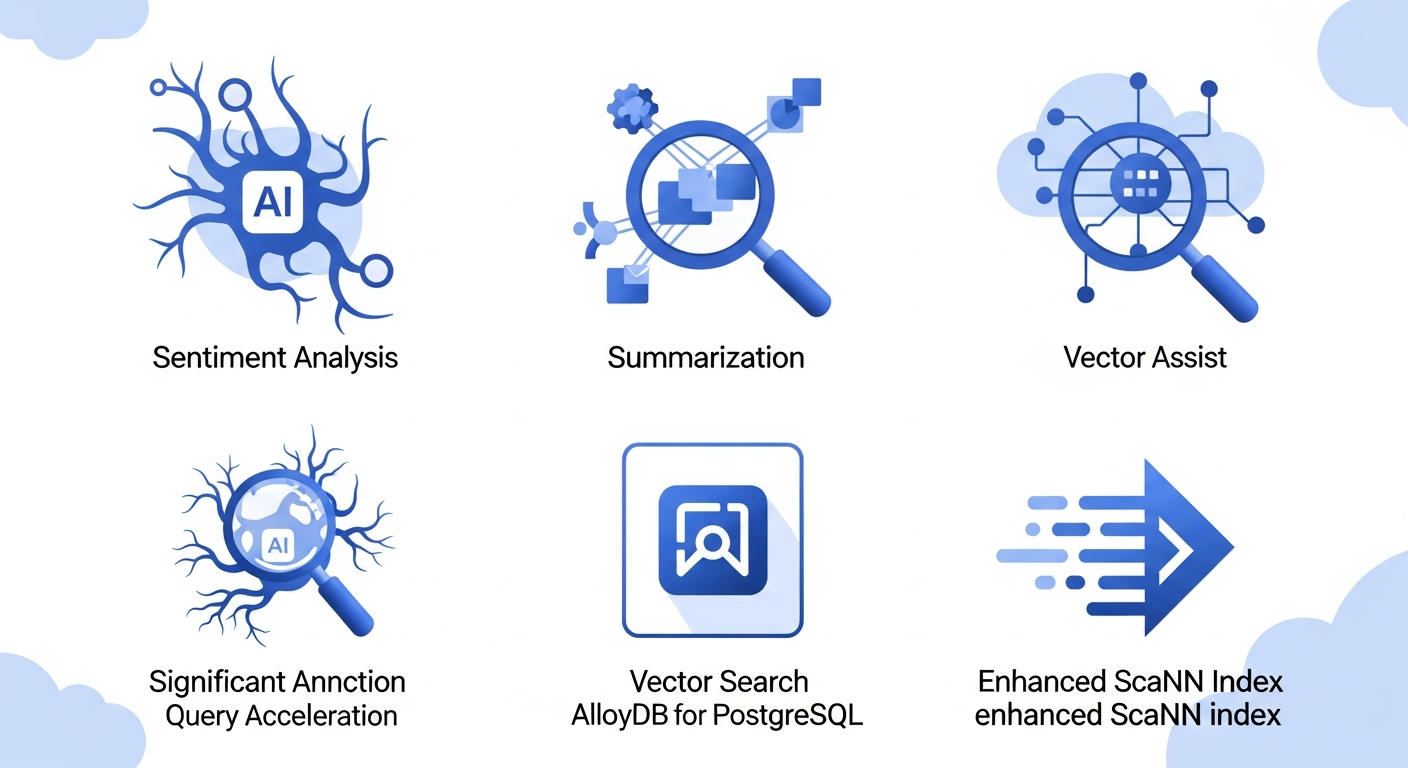
First up, the new AI functions. These are in Preview, but they look super useful. You can now do sentiment analysis directly in your database with ai.analyze_sentiment. Imagine processing thousands of customer reviews to figure out if people are happy or not, all within your database. That's pretty neat.
Then there's ai.summarize and ai.agg_summarize. These functions let you condense long texts, which is perfect for things like meeting transcripts or technical docs. And ai.agg_summarize can even give you a single summary from multiple rows, like all reviews for a specific product. This is a big deal for quickly getting insights from unstructured data.
Google also sped up existing AI functions like ai.if and ai.rank in PostgreSQL 17. They even introduced optimized AI functions that use smaller, faster proxy models. This means AlloyDB can often process AI queries locally, saving you those remote LLM calls and cutting down on costs. That's a clever move.
Now, let's dive into vector search, because this is where things get really interesting.
There's a new extension called Vector assist in Preview. This tool is designed to make your life easier when working with vector workloads in AlloyDB. It helps you set up things like embedding generation, query optimization, and even HNSW index creation. Basically, it’s about simplifying what can be a complex setup.
And get this, you can now defer ScaNN index creation. So, if you have an empty table or not enough data yet, AlloyDB won't try to build an index until it makes sense to. That's a small but mighty improvement.
For those dealing with massive datasets, the alloydb_scann extension now supports four-level tree indexes. This means it can handle up to 10 billion vector rows. Yeah, you read that right. Ten billion. That's a huge step up for really large-scale vector search.
Plus, adaptive filtering for vector searches is now Generally Available. This feature is super smart. AlloyDB's query optimizer will dynamically pick the best filtering strategy (inline or pre-filtering) based on your data. You don't have to fiddle with it, it just works better.
And to top it all off, ScaNN vector indexes are now automatically tuned and maintained. No more manual tweaking! AlloyDB will update centroids and manage your index as your dataset grows, giving you better query performance and search results without extra effort. That's a win-win.
These updates mean AlloyDB is becoming an even more robust platform for modern, AI-powered applications. Being able to do more of this directly in your database is a game changer. Less data movement, faster insights.
If you're curious, check out the official release notes for "Access Elasticsearch data from AlloyDB" and the documentation on "Evaluate sentiment and Summarize content" to dig deeper. It's definitely worth exploring these new capabilities.
Comments
Join the discussionNo comments yet. Be the first to comment.